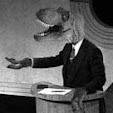
Americans - beyond a small enclave of Texans - will not need to listen to George W. Bush speak after January 20th, 2009 (although I'm sure quite a few haven't been listening recently, anyway). His mastery of the English language has brought us gems like "rarely is the question asked 'is our children learning?'", along with a rendition of Sunday Bloody Sunday. To be honest, his gaffes are minor compared to the illustrious James Danforth Quayle, who served as George H. W. Bush's vice president (maybe that's where Bush Jr. picked up some of those speech habits...). Many of the comedic, misspoken quotes ascribed to Bush are, in fact, Quaylisms. I suppose these sorts of things are going to crop up every once and a while if half the populace is voting for a guy they could "have a beer with."
 But let's not be too hasty in judging their eloquence and use of English. Although it is relatively easy to be understood in English, the language is difficult to master. So, I'd like to point out a few factoids and interesting usage nuances in the English language. First up:
Factoid
Contrary to its common usage in news broadcasting, a factoid is not a "little fact". The suffix -oid is not used to form diminutives. That is: adding -oid to the end of a word does not make it tiny or small. The suffix "-oid" means "resembling" (often "imperfectly resembling"). Proper diminutive suffixes would be -ette or -let, like cigarette or piglet (so, factette or factlet).
Compare factoid with cuboid (resembling, but not quite a cube) and humanoid (resembling, but not quite a human) and the problem becomes immediately apparent. A factoid resembles a fact, but is not quite a fact. The term was coined in the 1970s referring to a bit of misinformation that was repeated so often that it appeared to be factual. Apparently trivia is a much too trivial word for many news anchors.
Discreet and Discrete

Not a factoid: the robots in Futurama almost exclusively have square pupils (Hedonismbot and others have circular ones on occasion).
That's right, I jumped right into the homonyms. While less common than their/there/they're, to/too/two, and for/fore/four, discrete and discreet are exciting words that even Microsoft Word won't fix. Discrete means separate or distinct; discreet means prudent or unobtrusive (the more usual meaning). Just to confuse the Romans in the crowd: both words derive from the Latin descretus (separated/discerned). Discreet entered common speech and developed into 'prudent', while discrete stuck with the more intellectual groups that used Latin and retained something closer to its original meaning.
Ado About Adieu
Let us discreetly separate these two out into their discrete uses.
Adieu, like many English words, is stolen from French (technically a parent language of modern French - Occitan...but let's see you try to find a school that teaches it). Its original meaning - now buried under a husk of modernism and evolved connotations - was "(I/we commend you) to God". Convention in English was that when one party departed from another they would say "adieu" to those that remained, while those that remained would say "farewell" to the departing group ("fare thou well" if you want to get all Middle English on me). I don't think that convention lasted all that long, but it may be important to note that English was not the primary language of much of the the nobility in England until around at least the 1360s. Now "adieu" just functions as a fancy way of saying goodbye.
Adieu exchanges positions with ado quite frequently - particularly in "without further ado". Ado is a fancy northern Scandinavian contraction for at do or "to do". It has also developed more into a noun meaning "trouble" or "fuss". "Without further ado" announces that the speaker has said everything necessary and the ceremony/play/whatever may continue unhindered.
Without further stalling for time...
Going Farther (or Further) with Farther (and Further)
The most subjective of the group here, some people don't bother acknowledging a difference between "farther" and "further". Technically farther should only refer to physical or spatial distance ("That field is farther away than this one."), while further should refer to the extent or degree of something ("Further understanding will require a lot of work."). That said, the use of either is fine for most people...unless they are a grammar Nazi - in which case you'll probably want to avoid using affect and effect, too.
Just trying to effect understanding of English.